Popping Sound In Shoulder After Rotator Cuff Surgery
Crepitus is the medical term for a grinding, creaking, or grating sound or sensation that occurs when moving a joint. It can be produced by friction between bone and cartilage or the fractured parts of a bone when speaking in the context of bone joints. Crepitus can occur at any age, but more commonly develops as people get older.
- How To Dress After Rotator Cuff Surgery
- What To Expect After Rotator Cuff Surgery
- Recovery After Rotator Cuff Surgery
I had rotor cuff surgery my second one in a year to the same right shoulder, The first surgery on April 30, 2015 was great and about 2 months in my PT was on vacation and i had a sub she over extended my arm which caused a popping sound and then massive pain.
In the majority of cases, crepitus develops due to everyday use and changes that occur over time within the joint. It is usually a painless sensation and not of much concern from a medical standpoint. However, if crepitus is associated with pain upon moving the joint, further investigation is often warranted.
Sustaining a significant injury to a joint, such as the shoulder, can lead to the development of crepitus as well. In certain instances, having sensations of popping or clicking in the shoulder joints could signify a potential problem with your shoulder.
What causes shoulder crepitus?
Most of the time, the cause of crepitus can be predicted by a person’s age. If they are under the age of 30, chances are that their shoulder clicking sounds are the result of repetitive use or previous injury that has lead to loosening of the shoulder ligaments. This may be seen in young athletes that participate in contact sports. Those over the age of 55 with crepitus in the shoulder most likely suffer from degenerative changes in the joint itself.
The following are some of the common reasons for shoulder crepitus development:
Labral tears
The shoulder joint is comprised of a ball and socket which fit into each other effortlessly. A ring composed of dense fibrous tissue surrounds the shoulder joint socket called the labrum. It also serves as an attachment for the ligaments and helps the ball of the shoulder stay in position. If the labrum of the shoulder becomes torn or damaged from any sort of injury or repetitive stress it may result in the formation of crepitus. Those who have painful crepitus due to labral tears and don’t respond physical therapy may require surgery. Tears on the top of the labrum are referred to as a SLAP lesion.
Rotator cuff tears
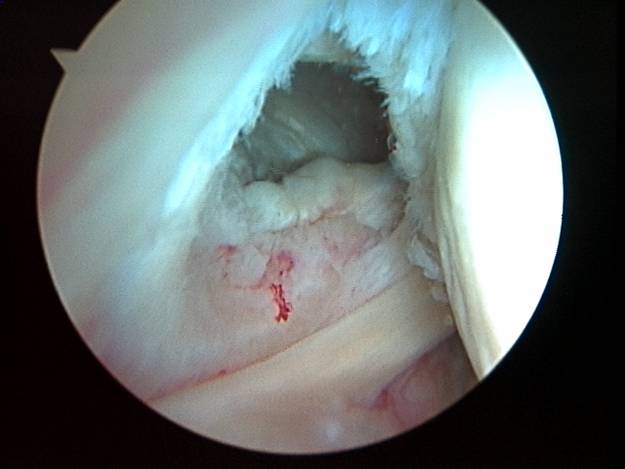
The rotator cuff is the part of the shoulder joint that is comprised of a group of muscles and tendons that surround the shoulder joint and helps to keep the head of the upper arm bone firmly within the ball socket. If the rotator cuff tendons become torn, a loose edge within the shoulder can catch on other ligaments or structures in the shoulder leading to painful crepitus. In cases of rotator cuff tendinosis, inflammation can also develop leading to further shoulder joint damage. The inflammatory process of joint is often called bursitis and may cause additional swelling leading to a clicking or popping sensation.
Shoulder dislocation
Typically occurs due to an acute injury, shoulder dislocations are a common cause of shoulder crepitus. Injury to the shoulder leads to the joint becoming looser and lead the ball of the shoulder to slide up or over the edge of the socket. When this ball falls back into place, a snapping or popping sounds can be appreciated.
Arthritis
Due to loss of cartilage surrounding the joint, cushioning that previously lined it is lost. This results in the surfaces of the shoulder bones to rub against each other during movement. The bones of the shoulder are naturally rough in nature and therefore cause clicking, snapping or popping sounds when cartilage is absent.
What are the symptoms of shoulder crepitus?
Symptoms may include sounds or sensations of:
- Crackling
- Grinding
- Cracking
- Creaking
- Grating
- Popping
If these symptoms occur without pain on movement, it is not considered a genuine issue. However, if pain were to be present, the condition should be taken seriously with medical treatment being pursued. It is important to note that the term crepitus is not exclusive to only joints, as it may be used to describe a crackling sound heard in the lungs of certain lung disorders.
Exercises for shoulder crepitus
Performing certain gentle exercises can help preserve function, increase strength and increase the range of motion in cases of crepitus. However, these exercises should be avoided if you are experiencing pain with your shoulder movements.
The following are easy to perform exercises you can try at home today:
Pendulum warm-up
This exercise warms up the rotator cuff of the shoulder. Sit toward the front edge of a chair and brace your left hand on your right thigh. While keeping your back straight, lean forward and to the right. Let your right arm dangle at your side while you gently swing it back and forth like a pendulum. Now, fully rotate the rotator cuff by performing a full circle with your right arm. Now repeat this exercise on your left side.
Exercise #1
Hold a towel in both hands with your palms facing upward. While keeping your elbows at your sides and bent at 90 degrees, slowly move your arms to the right and then to the left. Repeat this exercise two to three times, going a little farther each time while staying in your comfort zone.
Exercise #2
Wrap a towel behind your waist like a belt, holding its ends. While keeping your elbows at your sides, bend them at 90 degrees with your palms facing each other. Now slowly move your arms to the right and then to the left as you gently stretch the rotator cuff muscles.
Exercise #3
While holding a towel horizontally at shoulder height and shoulder-width apart, keep your palms down and turn the towel vertically. Do this first in one direction, then the other. Repeat this exercise two to three times.
Exercise #4
Holding a towel in both hands with your arms in resting position, slowly bring your arms upward to shoulder height. Do this exercise while still remaining comfortable and increase the height you raise the towel a bit higher each time. Lift the towel straight over your head as long there is no pain.
Exercise #5
With your arms a little further apart than shoulder width, raise your towel over your head. Now gently lower the towel down towards the top of your head then raise it back up again. Repeat this exercise two to three times.
Related: Shoulder blade (scapula) pain causes, symptoms, treatments, and exercises
If you have had shoulder surgery, you may benefit from the skilled services of a physical therapist to help improve your shoulder mobility and strength and decrease your pain. Your PT will work with you to help you return to your optimal level of function and activity after your surgery.
Common types of shoulder surgeries that may require physical therapy include:
- Rotator cuff repair
- Labrum repair
- Proximal humeral fracture reduction
- Clavicle fracture reduction
- Biceps tendon repair
- Subacromial decompression
Each of these surgeries carries with it specific treatments and techniques to safely achieve the best outcome. Some variables of a physical therapy program remain the same throughout; the basic goals during rehab after shoulder surgery are to safely improve range of motion (ROM), strength, and overall functional use of your arm. Your physical therapist can help you achieve those goals.
How To Dress After Rotator Cuff Surgery
Here is a list of some of the things that you may work on with your physical therapist after shoulder surgery. The list starts with simple passive motions and progresses in difficulty and stress as you progress through your shoulder rehab. This list does not replace the advice of your doctor or physical therapist. You must check with your doctor before starting these, or any other exercises after shoulder surgery.
Passive Shoulder Range of Motion Exercises
In the initial days and weeks after your shoulder surgery, you should be able to start your rehabilitation with your physical therapist. Your PT will show you how to don and doff your sling, and passive ROM exercises for your shoulder can be started. Gentle pendulum exercises can be used to relax your shoulder muscles and keep your shoulder joint moving properly.
While wearing your sling, you may find that the muscles of your forearm and wrist or hand feel like they are getting weak. Your physical therapist may have you perform some putty squeeze exercises to keep your hand and forearm muscles working properly as your shoulder heals.
You may use a pulley system in the PT clinic to help improve your shoulder ROM through flexion, abduction, and internal rotation. Using a pulley system at home may be necessary. Your PT may be able to lend you a shoulder pulley, or you can make one yourself with some simple hardware store items.
Shoulder Isometric Exercises
Isometric exercises are exercises where no motion occurs while the muscles around your shoulder are contracting. Isometric shoulder exercises are a great way to start to use your muscles again after shoulder surgery.
Even if you are still wearing your sling, you can perform shoulder isometrics to start engaging your rotator cuff muscles. This can help prepare your shoulder muscles for increased workloads in the coming weeks of rehabilitation for your shoulder.
Active Range of Motion Exercises
Once you start achieving full or near full passive ROM in your shoulder, your physical therapist may have you start active ROM exercises. These exercises are designed to get your shoulder and rotator cuff muscles contracting enough to move your arm and shoulder through its full range motion.
Don't be concerned if you initially find moving your arm difficult; your shoulder has been in a sling and has recently undergone the trauma of surgery. Your rotator cuff and deltoid muscles have not been called into action recently, so they may not be able to fully raise your arm. As you practice the active ROM exercises, you should find that your shoulder and arm function normally in a few short days.
Scapular Stabilization Exercises
Your shoulder is comprised of many different bones and joints. These joints must work together to give you the ability to lift your arm overhead. Your scapula, or shoulder blade, is the triangular shaped bone in the back part of your shoulder.
When you have pain or weakness in your shoulder after surgery, the muscles around your scapula may not function properly. This causes improper shoulder and scapular motion that must be corrected.
To overcome scapular muscle dysfunction, your physical therapist may have you begin scapular stabilization exercises. These exercises are essential to help you regain normal mobility in your shoulder complex.
Shoulder Rotator Cuff Strengthening Exercises
What To Expect After Rotator Cuff Surgery
Once you have improved the passive and active ROM in your shoulder, it will be time to add a little resistance to your shoulder exercises. You can use a resistance band, like a Theraband, to start rotator cuff strengthening. Your physical therapist should be able to give you a resistance band. The bands are color-coded based on the amount of tension each band provides.
You can also use a small dumbbell to add resistance to your active range of motion exercises. After surgery, it is important to start light and slowly increase the sets and repetitions of each exercise before adding additional weight to the exercise. Your physical therapist will help you progress through your shoulder and rotator cuff strengthening program.
Overhead Throwing and Reaching Exercises
Once your shoulder has healed sufficiently after surgery and you are gaining good strength in your rotator cuff and scapular musculature, you may be ready to start performing more advanced overhead exercises.
The Thrower's 10 exercises are a group of exercises designed to improve the strength and mobility of your entire arm so you can prepare for more advanced overhead activities.
When returning to throwing activities, start out easy. Start with a gentle soft toss, and progress your throwing gradually over a period of weeks. No need to get out there and start gunning it; start with simple throws over a short distance and gradually increase the number of throws your do and the distance between you and your throwing partner. Do not progress to advanced overhead throwing and strengthening activities until your doctor or physical therapist advises you to do so.
Advanced Shoulder Plyometrics
When you think of jumping and bouncing that occurs in plyometric exercise, you typically think of the legs doing the work. But you can also perform plyometric exercise for your arms and shoulders.
If you are an athlete or if you work in a job where you may have to quickly catch or throw something, then you may benefit from performing shoulder plyometric exercises.
Specific exercises like using the Bodyblade or using small weighted therapy balls can train your shoulders and arms to respond quickly whenever you need to catch or throw something.
A Word From Verywell
If you have had shoulder surgery, you may benefit from physical therapy to help you progress through your rehabilitation. By starting gently with passive ROM and progressing through active ROM and rotator cuff strengthening, you can be sure to safely and quickly get back to your normal activities.
Recovery After Rotator Cuff Surgery
- Chang, K. V., Hung, C. Y., Han, D. S., Chen, W. S., Wang, T. G., & Chien, K. L. (2015). Early versus delayed passive range of motion exercise for arthroscopic rotator cuff repair: a meta-analysis of randomized controlled trials. The American journal of sports medicine, 43(5), 1265-1273.